
Observability, Automation, and AI: The New Skill Stack for DevOps Engineers
DevOps engineering is changing again.
Earlier, DevOps was mainly about automation, CI/CD, infrastructure, cloud, containers, monitoring, and reliability. These skills are still important, but modern engineering teams now expect more.
Today, DevOps engineers also need to understand observability, automation, and AI together.
This combination is becoming the new skill stack for AI-era engineering.
Observability: Understanding What Is Happening
Monitoring tells you when something is wrong. Observability helps you understand why it is wrong.
This is an important difference.
Modern applications are no longer simple. They run across microservices, Kubernetes clusters, cloud platforms, APIs, databases, queues, and third-party services. When something fails, the root cause is not always visible from one dashboard.
That is why DevOps engineers need strong observability skills.
They should understand logs, metrics, traces, alerts, dashboards, and service dependencies.
Logs show what happened inside the application. Metrics show performance over time. Traces show how requests move across services.
Together, these signals help engineers investigate incidents faster and understand system behavior more clearly.
Automation: Reducing Repetitive Work
Automation has always been a core part of DevOps.
DevOps teams automate builds, tests, deployments, infrastructure provisioning, scaling, monitoring alerts, rollbacks, and security checks.
Automation helps teams reduce manual effort, avoid repeated mistakes, and deliver software faster.
But traditional automation usually works through fixed rules.
For example, if a build passes, deploy it. If CPU usage crosses a limit, send an alert. If a container fails, restart it.
This works well for known situations, but modern systems often create problems that are not simple or predictable.
That is why automation alone is no longer enough.
DevOps engineers need to understand how automation can become smarter with better data and AI-assisted decision support.
AI: Adding Intelligence to Operations
AI is adding a new layer to DevOps work.
It can help teams analyze large amounts of operational data, detect unusual patterns, reduce alert noise, summarize incidents, and support root cause analysis.
This is where AIOps becomes important.
AIOps means using AI for IT operations. It helps DevOps and SRE teams move from reactive operations to smarter, data-driven operations.
For example, instead of manually checking hundreds of alerts, AI can help group related alerts and highlight the most important issue.
Instead of reading long logs line by line, AI can help summarize error patterns.
Instead of starting every incident investigation from zero, AI can help show what changed recently and whether similar issues happened before.
AI does not replace DevOps engineers. It helps them work with more clarity and speed.
Why These Skills Work Together
Observability, automation, and AI are not separate skills anymore.
They support each other.
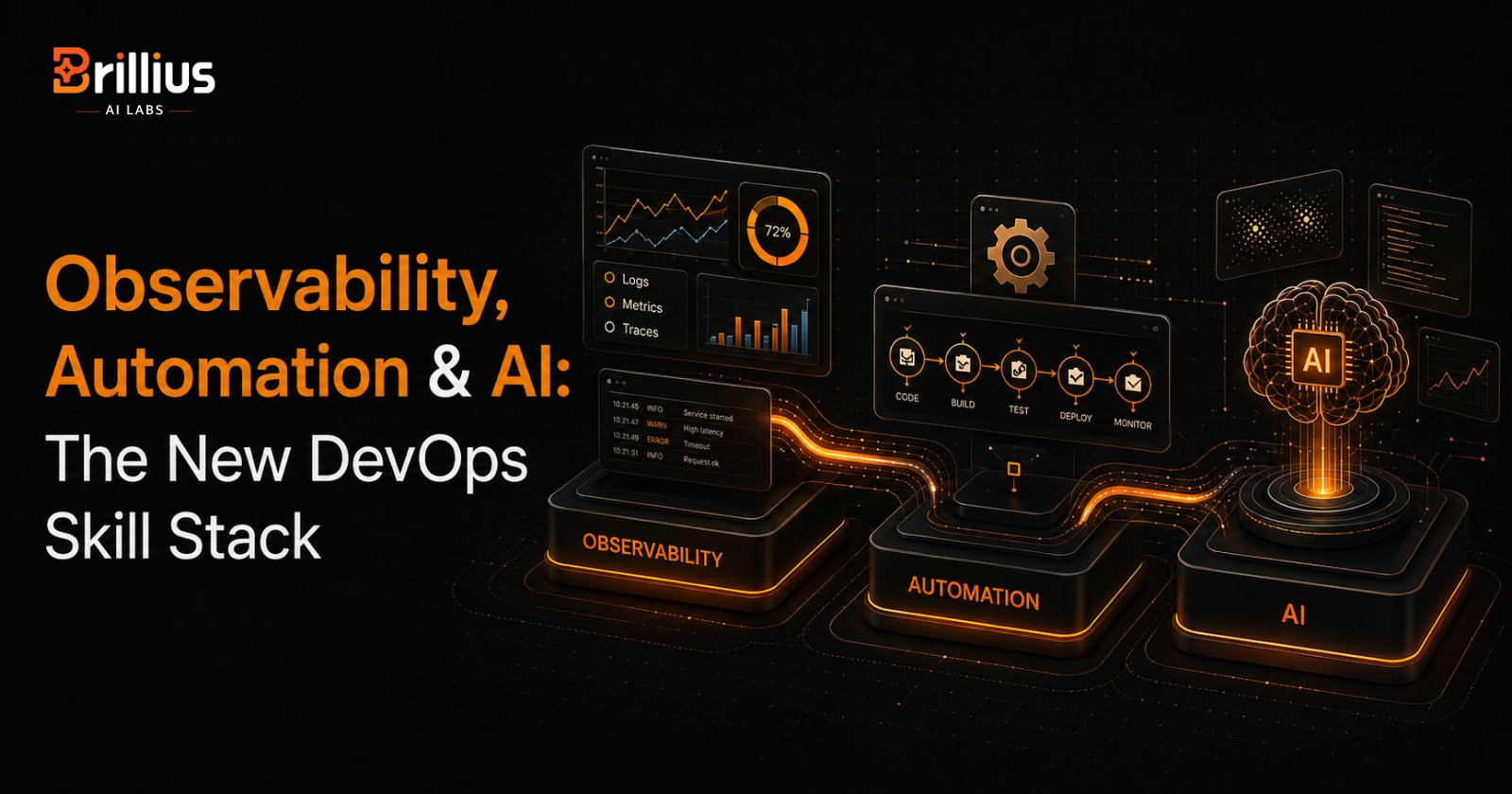
Observability gives the data.
Automation takes action.
AI helps understand patterns and recommend next steps.
For example, if a service is slowing down, observability tools may show increased latency. AI can help detect that the pattern is unusual and connect it to recent changes. Automation can then support the response, such as scaling resources, restarting a service, or triggering an incident workflow.
The engineer still makes the final decision.
This is why DevOps professionals need both technical skills and judgment.
What DevOps Engineers Should Learn
To stay ready for AI-era engineering, DevOps professionals should focus on practical skills.
They should strengthen observability fundamentals, understand logs, metrics, and traces, improve automation workflows, learn basic AIOps concepts, and practice with tools like Prometheus, Grafana, Jaeger, Kubernetes, and cloud monitoring platforms.
They should also learn how AI can support incident response, documentation, troubleshooting, and operational decision-making.
The goal is not to become a data scientist.
The goal is to become an AI-aware DevOps professional.
Final Thought
The future of DevOps is not only about automation.
It is about intelligent operations.
DevOps engineers who understand observability, automation, and AI will be better prepared for future roles in AIOps, platform engineering, SRE, and AI-augmented operations.
The new skill stack is clear: observe better, automate smarter, and use AI responsibly.
At Brillius AI Labs, we help professionals prepare for AI-era engineering through practical and career-focused learning, supported by:
AI Learning Path - structured guidance for DevOps to AIOps growth.
AI Assistant - instant support for technical doubts and concepts.
AI Cloud Labs - hands-on practice in cloud-based environments.
AI Interview Coach - interview preparation with AI-led feedback.
AI Adaptive Quiz - quick knowledge checks to improve retention.
AI Dashboard - learning progress and performance tracking.
AI Resources - curated content for continuous AIOps learning.


